
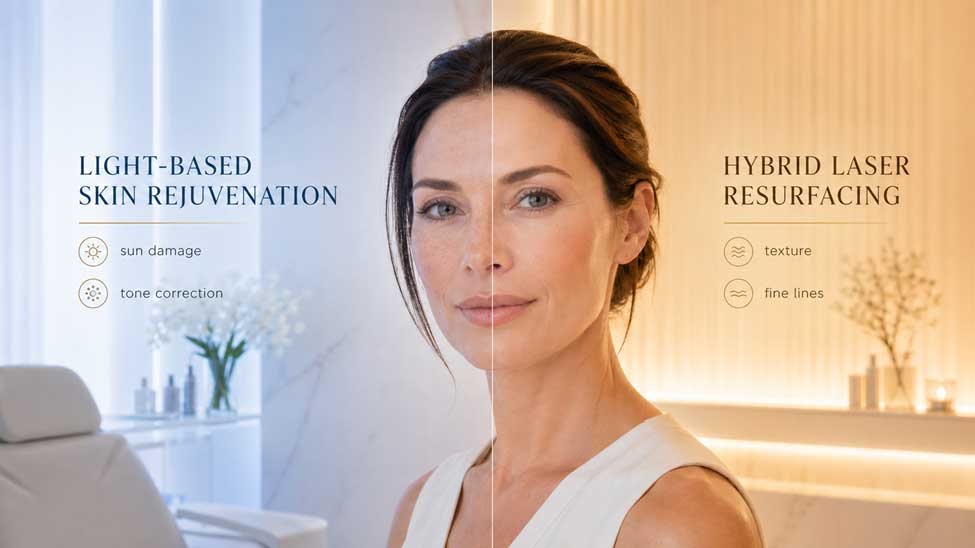
If you are researching BBL laser options, you may be comparing two of the most talked-about skin rejuvenation treatments: BBL and Halo. Both can improve visible signs of aging and sun exposure, but they work differently. BBL is a broadband light treatment often chosen for pigmentation, redness, brown spots, freckles, sunspots, and overall tone. Halo is a hybrid fractional laser treatment often chosen for texture, pores, fine lines, acne scars, and deeper resurfacing.
The easiest way to think about the difference is this: BBL is often more pigment and redness-focused, while Halo is often more texture and resurfacing-focused. Many patients benefit from one or the other. Some benefit from both, either in a staged sequence or a long-term skin rejuvenation plan.
At Marin Medical Aesthetics in San Anselmo, treatment planning starts with your skin concerns, skin type, sun exposure history, downtime tolerance, and aesthetic goals. That is especially important in the Bay Area, where outdoor lifestyles and years of sun exposure can create a mix of pigment, redness, fine lines, and uneven texture.
What BBL Does Best
Forever Young BBL uses broadband light to target visible color changes in the skin. It is often considered for age spots, sun damage, hyperpigmentation, redness, rosacea-prone discoloration, freckles, brown spots, sunspots, and uneven skin tone.
BBL is related to intense pulsed light (IPL) because both use broad-spectrum light energy rather than a single laser wavelength. During treatment, light energy is absorbed by selected targets in the skin, such as pigment or visible vascular color. Over time, this can help the complexion look clearer and more even.
Patients often choose BBL when they say their skin looks blotchy, red, sun-damaged, freckled, or uneven. It may also be used in Forever Young BBL maintenance plans for patients focused on early signs of aging and long-term skin quality. However, BBL is not the strongest choice for deeper acne scars, etched lines, or significant texture concerns.
What Halo Does Best
Halo laser treatment is a hybrid fractional laser that uses both ablative and non-ablative wavelengths. This means it can treat the epidermis and dermis in a controlled way, supporting resurfacing and collagen remodeling.
Halo is often considered for sun damage, hyperpigmentation, fine lines, enlarged pores, uneven skin texture, acne scars, melasma-prone discoloration in selected candidates, and overall dullness. It may be a better fit than BBL when texture is the bigger issue, because fractional laser treatment creates controlled microscopic treatment zones that stimulate repair.
Compared with BBL, Halo usually involves more noticeable recovery. That recovery can be worth it for patients who want a more substantial resurfacing effect, but downtime, aftercare, and sun avoidance need to be part of the conversation. Mayo Clinic notes that laser resurfacing may be used for age spots, uneven color or texture, sun-damaged skin, and mild to moderate acne scars, while also carrying risks such as irritation, infection, and pigment changes. That is why careful provider selection matters.
BBL vs. Halo For Sun Damage
For brown spots, freckles, sunspots, and diffuse pigmentation caused by sun exposure, BBL is often a strong starting point. It can target color irregularities without the same resurfacing intensity as Halo. Patients who want a brighter, clearer complexion with less downtime may prefer BBL if they are good candidates.
Halo may be better when sun damage is paired with rough texture, larger pores, fine lines, or a crepey surface. It can help address damage you can see and textural changes that make light reflect unevenly from the skin’s surface.
The American Academy of Dermatology notes that procedures such as laser therapy and chemical peels may be used for age spots, but treatment choice depends on the spots, skin, and risk of side effects. In practice, that means your provider should determine whether a spot is appropriate for aesthetic treatment and whether a medical evaluation is needed first.
BBL vs. Halo For Redness And Rosacea-Like Color
BBL is often favored when redness, visible vessels, flushing, or rosacea-like color is the main concern. Broadband light can be adjusted to address vascular-looking discoloration in appropriate candidates. Halo is not usually the first choice for redness alone because it is more of a resurfacing treatment.
That said, many patients have both redness and texture. A provider may recommend BBL first to reduce redness and pigment, then Halo for texture and fine lines. Others may start with Halo if texture is the dominant concern and use BBL for maintenance.
BBL vs. Halo For Texture, Pores, And Acne Scars
Texture concerns usually point more toward Halo, microneedling, RF microneedling, or a combination plan. Halo can be useful for enlarged pores, dull texture, fine lines, and some acne scars because it stimulates the skin’s repair process through fractional resurfacing.
BBL may make acne marks look better when color is the issue, such as post-inflammatory redness or brown pigment. But if the scar is indented, tethered, or ice-pick shaped, light-based pigment treatment alone is unlikely to be enough. In those cases, a provider may discuss Halo, microneedling, subcision, fillers, or other treatment options.
When A Combination Plan Makes Sense
A combination plan can make sense when skin concerns are layered. For example, one patient may have brown spots, rosacea-like redness, enlarged pores, and acne scars. Another may have sun damage, fine lines, rough texture, and uneven skin tone. Treating only one layer may leave the patient disappointed.
A staged plan might include BBL for pigment and redness, Halo for resurfacing, ClearSilk for gentle maintenance, microneedling for collagen support, Botox for expression lines, or medical skincare for pigment prevention and barrier support. The sequence matters. Your provider may recommend skincare preparation, sun avoidance, or a certain time of year to reduce risk.
Downtime And Recovery Differences
BBL is often described as non-invasive with limited downtime, though temporary redness, warmth, pigment darkening, or mild swelling can occur. Patients should avoid sun exposure and follow aftercare closely. BBL candidacy depends on skin tone, pigment history, active tan, and medications.
Halo usually has more visible recovery. Depending on settings, patients may experience redness, swelling, roughness, bronzing, peeling, sensitivity, and a need for careful post-treatment skincare. The skin’s surface is renewing, so sunscreen and gentle care are essential. Results appear gradually as the treated skin heals and collagen remodeling continues.
Neither treatment is a substitute for daily sunscreen. Without consistent sun protection, new pigment and sun damage can develop and undo some of the visible improvement.
How Skin Type Affects The Decision
Skin type and skin tone are central to treatment selection. Pigment-targeting treatments can carry a higher risk of unwanted darkening or lightening in some patients, especially with recent sun exposure or darker skin tones. Halo settings also need to be selected carefully to reduce risks such as post-inflammatory hyperpigmentation.
A good provider will ask about tanning, melasma, hyperpigmentation, prior laser reactions, skincare actives, history of cold sores, and upcoming travel. If you have a big outdoor event, beach vacation, or active sun exposure planned, your provider may recommend waiting.
How Marin Medical Aesthetics Helps You Choose
At Marin Medical Aesthetics, your consultation includes a discussion of your skin concerns, desired results, downtime, skin tone, treatment history, and long-term skin goals. Your provider may recommend BBL, Halo, ClearSilk, microneedling, RF microneedling, or another treatment option, depending on what your skin actually needs. We value objective data, which includes before and after photos as a value add at no additional cost for the procedure.
BBL And Halo FAQs
Q: Is BBL The Same As IPL?
A: BBL is a type of broadband light treatment and is often discussed alongside IPL. Both use broad-spectrum light energy to address pigment and redness, but devices, settings, and treatment protocols differ.
Q: Is Halo Better Than BBL?
A: Halo is not better for every concern. It may be better for texture and resurfacing. BBL may be better for brown spots, redness, freckles, and tone.
Q: Can BBL Treat Fine Lines?
A: BBL may support overall skin quality and early signs of aging, but etched texture and deeper lines may need Halo, microneedling, RF treatment, injectables, or another option.
Q: Can I Do BBL And Halo Together?
A: Some patients benefit from both, but timing depends on your skin type, goals, and provider’s protocol. Here at Marin Medical Aesthetics, we prefer to do both on the same day: this way, you get all your results immediately, and with only minimal downtime.
Q: Which Treatment Has Less Downtime?
A: BBL generally has less social downtime than Halo. Halo usually involves more visible resurfacing recovery, but it can be more appropriate for texture.
Ready To Choose The Right Light Or Laser Plan?
If you are comparing BBL laser treatments in San Francisco, Marin County, or the greater Bay Area, Marin Medical Aesthetics can help you decide whether BBL, Halo, ClearSilk, microneedling, or a combination plan best fits your skin concerns. Schedule a consultation in San Anselmo to build a treatment plan around your skin tone, sun history, downtime, and goals.
Related Resources:
- Achieve Your Dream Body in 2026 in San Anselmo
- Ultrasound vs. Radiofrequency Treatments in San Anselmo
- Non-Surgical Skin Rejuvenation in San Anselmo